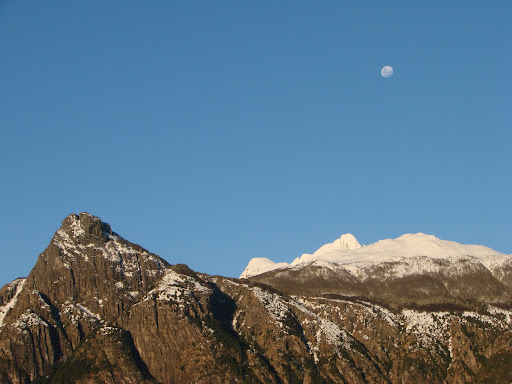
It almost feels like spring in Coyhaique, although a chill lurks in the air as the sun begins to wane, and I already know that sunny days signal brutally cold nights. I sit in a stone and dirt amphitheater above the Esculea de Guias Patagonia, nursing the maladita caña, drinking a coke because there weren´t any ice cream bars at the bodega, and lamenting the nasty film that it leaves on my teeth. The mountains, now such a familiar and comforting presence, are back lit by the sun and sit behind a screen of smoke. The Saturday afternoon ambient soundtrack consists of a hammer pounding somewhere nearby, the bounce of a basketball, and the ever present chorus of barking dogs, with the new addition of chirping birds and the occasional accent of a child´s laughter and rumble of old truck.
It is just too familiar, this lazy Saturday afternoon in Coyhaique. Could it be that Saturday afternoon feels the same everywhere? Or could it be that Coyhaique just feels familiar? A helicopter punctuates the soundtrack in a very Dark Side of the Moon-esque moment, although it really just reminds me of the glider port in Franconia, New Hampshire.
I sit in the sun with my trusty Red Sox cap shielding me from the ozone hole and I think about my sister, moving into a new apartment and undoubtedly stressing about all the details. I think about my parents, perhaps drinking Syrah and Pinot Grigio in the adirondack chairs on the lawn or grilling up some fish for dinner. I think about my shiny green truck, waiting for me obediently and most likely parked next to the tool shed. I imagine the soundtrack of Sherry Lane: wind chimes, the cars passing by on County Road, and the occasional train whistle heard through the woods. I envision the angle of the late afternoon sun on the herb garden, with Kinley perhaps basking in the last light on the deck.
I dream about those glorious Cape Cod summers of shorts and sunburns, baseball games and fireworks, and melted ice cream stuck to your forearm. And I know that someday I will also dream about these glorious Patagonian winters of woodsmoke and red wine, chamamé and smoky candlelit bars, and the salvation of a heated taxi on a cold night. And today, on this sunny Saturday afternoon in Coyhaique, I swear that I can smell somebody nearby firing up a grill. I wonder if there might be a chill lurking in the air as the sun begins to wane on Sherry Lane.
**A note: To those of you concerned about the recent earthquake in Peru, I am considerably south (about 2,000 miles or so) and did not feel a thing. However, the earthquake is all over the news down here and has served to remind me of the strong resentment between Chile and Peru. "Why should we help them," many Chileans ask, "when they just want to take our land and infiltrate our country with poor immigrants..."
Sound familiar?
Thursday, August 23, 2007


Friday, August 3, 2007
Llegadas y Despedidas
After three idle weeks in Coyhaique, I feel quite energized by my return to school. The kids even seem happy to be back, and ready to learn. They diligently copy new vocabulary into their notebooks as I watch with suspicion. Surely this motivation will dwindle in the coming months. Many of my students are noticeably thinner, presumably from the lack of government subsidized meals over vacation. When I ask if anyone traveled, they all stare at me blankly. “I went to the campo,” Mariana offers. “Pura pega! (pure work),” complains Saul. Later in the class, Saul lifts his desk off the floor and points its legs outward pretending they are machine guns. “Chicka, chick...boom!” he shouts, shooting down his classmates. Some of them are ready to learn, anyway.
Señora Hilda, the director of our school, has completed her contract and thus must leave Coyhaique. I am a little perplexed as to why this is happening in the middle of the school year, but I don´t question it. The school stages an elaborate goodbye ceremony, complete with speeches, dancing, and singing. It is a teary affair, and as Hilda exits the building, the students all rise to their feet singing. I am amazed to see how many students are crying as they file out of the gymnasium.Their eyes speak of abandonment. I had no idea they were so attached to her. I´m starting to realize why people say Americans are cold.
Almost every goodbye is offset by an arrival, and Maria Teresa and Ernesto finally arrive home today after three weeks of traveling. I surprise myself- I think I actually missed them! Maybe I am not so cold. In any event, it is nice to observe the ritual of coming home after a long journey. They tell stories and show pictures about the places they went, but you can tell by the content look in their eyes that their own home is “just right.” I think about my own comings and goings, and how sometimes the best part of leaving is being welcomed back. Other times, like Hilda, we leave without coming back, but we hope that we will be missed.
Sometimes I feel that life is just a long string of hellos and goodbyes, or arrivals and farewells, as we each navigate our own winding roads. But what matters is the substance between those hellos and goodbyes. Do we stop long enough to belong somewhere? To mean something to somebody? To leave a footprint? And when we move on, will we journey stronger? And when we´ve found home, will we know it?
Tuesday, July 31, 2007
Dreaming Northward
I find my way out of Coyhaique at last, striking north on the Carretera Austral for Puyhuapi. Juan Pablo, who offered to drive and save me valuable time on the bus, said the trip would be fast and concentrated, like a dream. It was.
We get a late start out of town, about 2:30 in the afternoon, with the sun high overhead. North of Aysén we pass the tiny settlement of Manihuales, and shortly thereafter the pavement ends and the landscape begins to change. The forest stretches in all directions: damp, dense, and green. I am overwhelmed by its frantic and reckless tangles. As always in Patagonia, the snowy peaks of the Andes surround us and enclose our world with an impressive border. They seem to become sharper and markedly more severe as we head north. The moon already chases behind us, and Jaco Sanchez sings "Tengo que pensar..." on the radio while we climb hairpin turns to cross the pass. I am lost in my thoughts, deep into the dream, and fixated on the enormous green ferns and spindly lenga trees hugging the road.
It is dusk when we arrive at Fijordo Queulat, but there is just enough light to make out the glassy water of the ocean meandering inland to meet the peaks. The carretera hugs the fijord and deals us endless potholes and sharp turns, until night finally closes in and the lights of Puyhuapi illuminate the distant shore. Puyhuapi, a tiny scattering of cabañas and German bed and breakfasts, is silent and tranquil in the darkness. The stillness of the mountains and the water, and the palpable sense of isolation create a distinct feeling of peace.
In the morning, a rare sunny day in this perpetually rainy climate illuminates the landscape anew. Everyone in Puyhuapi seems desperate to talk to us, as if they´ve been awaiting visitors in solitude all winter. They probably have. We converse with the German owner of a hand-woven rug business and shuffle around the edge of the fijord. We then head back south to the looming Ventisquero Colgante, a massive hanging glacier suspended between two peaks and reflected in a luminescent blue lagoon.
Late afternoon, and we fly back down the carretera and over the pass, stopping to pick up two hitchhikers who happen to know Juan Pablo. Patagonia is enormous and yet surprisingly small...there are so few people it is not uncommon to find an acquaintance in the middle of the wilderness 400 miles away. Our companions bring renewed energy to the cab of the truck as they recount their journey and plans to walk through the night if no car had stopped. I ponder that possibility.
Eventually we all lapse into silence, watching the moon rise and the peaks turn a warm pink. The moon is full, and this time we are chasing it, until the peaks become dark shapes and the lights of Coyhaique appear in the valley below. Night has definitively fallen by the time we hit our first traffic light. Awake from the dream, I struggle to hold onto some tangible evidence that it was real. Even the photographs seem to lie. Asi es la Patagonia.
Tuesday, July 17, 2007
Elsewhere
The days of winter vacation are passing rapidly and marked mostly by weather: sun yesterday, rain today, temperature dropping or rising... some days the fire starts easily and other days not so much. I am working on my motivation to leave Coyhaique and explore, but in winter the idea of riding a bus six hours to sleep in an unheated cabana is slightly unappealing. In any event, my recent surplus of free time has allowed me to reflect on life: here, elsewhere, and anywhere.
In a little more than three months I have ceased to think twice about powdered milk and coffee, having to relight a pilot halfway through the shower, and sometimes sleeping in a mummy bag under my blankets. I have perfected my "ciao," switched my cellphone language to Spanish, and even incorporated the ever present "po" into my vocabulary. (Po is an abbreviated form of pues, and Chileans use it to emphasize everything, i.e. sipo, nopo, obviopo.) Adapting to existence in a foreign culture is an odd thing. I sometimes wonder if I will continue to put mayonnaise on rice and eat pizza with mustard and hot sauce when I return to the states. What will I do without a wood stove to warm up my socks and red wine? Will I never dance chamamé again?
But the most pressing realization about life at the bottom of the world is how little things really do change. I have my daily routine, I go to the gym, I hang out with friends, I have a boss I don´t like, I struggle the same struggles and think the same things. We can´t escape who we are or the essence of our existence no matter how much we try to change the details. And for me, this is a very important point. I believe in the power of a journey to profoundly change a person, but I don´t believe we can depend on exotic experiences to make us who we are. At the end of the day in Coyhaique, I lay in bed and listen to the rain falling outside my window. And if I close my eyes, I could almost be on 5 Sherry Lane, wondering what tomorrow will bring.
Friday, June 22, 2007
Love and Vomit
The snow continues to fall in Coyhaique, but life goes on as usual. I don´t think that "snow days" exist in Patagonia. The roads are never plowed or salted, the sidewalks are covered in ice, and people carry on with their routines in their snow boots and four wheel drive vehicles. Almost everyone in Coyhaique drives a truck or a jeep. Yesterday I was walking through the central plaza, admiring the snow on the trees, when I took my first official fall on a patch of ice. Guess I´ll have to walk more carefully from now on.
School vacation beckons a mere week and a half away! I am now fully settled into my new classroom which was promptly christened by a vomit incident the first day I taught class there. Perhaps vomit can be seen as an auspicious sign. In any event, my new room gets full sun during the day and is significantly warmer, and the kids seem to behave much better there. I am teaching them how to say "What´s up," and "Just chillin´," which is at the very least amusing for me. Some boys have discovered how to say "I love you," and now when I walk in the halls I am constantly greeted by declarations of love from eleven year olds. Life could be worse!
The best thing I can say about my job here is that everyday when I go to work the kids are genuinely happy to see me. The never tire of kissing me on the cheek or offering to carry my schoolbag. They may not stay in their seats or care about the verb "to be," but they seem to have adopted me into their lives. And they are desperate for any sort of affection! I can already tell that it will be tough to leave these scrappy little buggers behind...
Monday, June 11, 2007
When the snow falls down....
As I celebrate my 25th birthday down here at the end of the world, I can´t help but think that a chain of events over a quarter century has been leading up to this experience. Perhaps it is the snow falling in June, or perhaps it is the Chilean wine, but it seems that on this birthday I have finally got it all right.
In any event, I kicked off my big 25 with hugs and kisses from all the teachers and students, and rounds of "Happy Birthday" in every class. My family threw me a big party and I discovered the Chilean birthday tradition: you get your face shoved in a cake. They got me good...the poor unsuspecting gringa! And then the snow began to fall, illuminated by the streetlights and blanketing the sidewalks, and it hasn´t stopped since! Welcome to winter in Patagonia!
In other news, I was informed that I need to change classrooms, so in the middle of the year I have to rip all my decorations and lettering off the wall and move across the hallway. Chileans really know how to make you feel special on your birthday but have no idea how to run a school! Or something like that. But the best you can do is just shut up and do what needs to be done, a good lesson learned in the English Opens Doors Program. The important thing is that I am starting to break through to the students, and they can now respond in English to "How are you?" A small but exciting achievement.
And so as the snow continues to fall I can say that I am one year older but infinitely wiser and stronger after only a couple of months at 49 degrees south... six months and a very long winter await.
Thursday, May 31, 2007
And then it was winter...
Sunday morning I woke up in a small farm house in the middle of the mountains at Bahia Murta, five hours south of Coyhaique on the mostly unpaved Carretera Austral. I was staying with friends of my family, on a lumpy mattress stuffed with wool. The lamb meat hanging outside the window was rock hard, and a sparkly white frost covered everything. I turned on the faucet and got nothing, as the pipes had frozen over night. Needless to say, winter suddenly arrived.
Back here in Coyhaique I am getting my first taste of constant cold. My classroom clocks in at a balmy 32 degrees Fahrenheit every morning, and even with the wood stove going I am lucky to break 40 by the end of the day. Everyone is preoccupied with obtaining wood, and conversations often turn to the price of wood or where it can be found in the campo. Every year Coyhaiqenos have to travel further outside of town to get wood, and this drives the prices higher and higher. For some people here, a month of wood costs almost an entire month´s salary. Maria Teresa tells me that many of my students go home to houses without fire, as their families can´t afford it. "Es complicado," they say.
Needless to say, winter has taken on a different meaning. I am trying to get the hang of getting up every three hours and adding wood to the fire, but I fail to get out of the warm bed all to often and have to endure getting dressed in the freezing cold morning. Perhaps less blankets on the bed would actually be a good thing. I teach my classes in full winter gear: long johns, pants, boots, three shirts under a sweater and a wool coat. My new classroom management problem is keeping the kids from crowding around the wood stove.
And so we wait for the first big snow, but winter is definitely here. All the reason to keep warm and dance more Chamamé...
Subscribe to:
Posts (Atom)