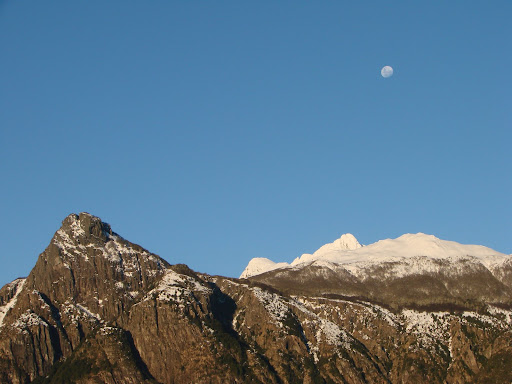
As Coyhaique geared up for its 78th Anniversary Celebration, Red Sox Nation in Patagonia got ready to watch the Sox face the Tribe in the ALCS. Or so I hoped, but it turns out that Fox Sports in Chile was more interested in broadcasting soccer. In any event, Coyhaiquenos hit the town all weekend in their gaucho best, with parties and parades in the plaza and colossal maté drinking gatherings called matéados.
Friday my students show up at school in their best uniforms and we march all the way down the hill to the plaza to join the big parade. They are hassled to tuck in their shirts and instructed to maintain a precise arm´s length of distance between themselves and the person in front of them. We arrive at the plaza and wait almost an hour in the hot sun, many students ditching out of formation to obtain balloons. When it is finally our turn to make the loop around the plaza, I am left in charge of about 5 balloons, which I juggle with my video camera like a harried soccer mom.
Later that night Rob, Pete and I gather around the kitchen table at my new place drinking maté out of a grapefruit and attempting to explain the rules of baseball to my roommates Alberto and Rodrigo. We have to settle for Arizona against Colorado on ESPN, but it is baseball nonetheless. Alberto is horrified by the organ music playing in the background. We explain that it is tradition, but he can't understand how anything so annoying and ugly could become tradition.
Saturday night I find myself alone in my Sox hat watching the tediously boring play-by-play on mlb.com and doing what Sox fans do best... grimacing in horror as my team falls apart in the tenth inning. While I hear strains of chamamé playing in the distance, I find an odd comfort in the disappointing loss, as if I'm not that far away from home after all. I may not be singing "Sweet Caroline" during the seventh inning stretch, but as long as I maintain blind faith in the big bats of Manny Ramirez and David Oritz, I am somehow united with my fellow Massholes.
So late Saturday night, mourning the loss, I raise my maté to Boston and the River Charles, to Patagonia and to the windburned gauchos with their boinas and scarves and black boots across the countryside. I also raise a toast to my favorite Massholes, my Mom and Dad. Happy Anniversary! And to Mom: Happy Birthday! I'd like to think that I am present in some way to celebrate with you guys, and that perhaps the world is not as big as it seems.
Tuesday, October 16, 2007


Sunday, October 7, 2007
"Silence is an argument carried out by other means."
 Saturday night I find myself packed into a community function hall with families, toddlers, hippies, professionals, intellectuals, and various Coyhaique citizens to observe the 40th anniversary of the death of Ché Guevara. We are each handed a copy of the famous farewell letter Ché wrote to Fidel Castro upon leaving Cuba, which is read carefully by a maté sipping Patagonian accompanied by acoustic guitar. It is hard not to feel emotional as we watch slides of the famous pan-American icon in the various stages of his life. Ché is a true hero to many of us.
Who isn´t seduced by Ché: his image, his words, his story, his life. I often find myself thinking about the journey that rattled the young medical student so deeply that he chose the path of revolution and never looked back. It is a well-loved story, the story about the development of a man who according to Sartre "...was the most complete human being of our age." What Ché found in the mines, cities, hospitals, and faces of South America is not unlike the many injustices and tragedies that we face today. Ché had the remarkable courage to acknowledge these truths. He accepted the responsibility of his awareness and the challenge to fight the impossible.
For this reason he is a hero of mine.
A little boy is running up and down the aisle shouting "Pirates!" as a banner with Che´s likeness is unfurled at the end of the ceremony. I shuffle with the crowd out into the Coyhaique night, six months deep in my own journey. Am I transforming? I think about every day that I have walked the halls of Escuela Victor Domingo Silva, every moon I have watched rise over the mountains, every lake, river and road I have crossed, and every tear of frustration shed. Will I too become a complete human being?
"If you tremble indignation at every injustice then you are a comrade of mine."
-Ernesto Ché Guevara 1928-1967
Thursday, September 27, 2007
And A River Runs Through It
The weekend before Dia de Patria (September 18th), Coyhaique bursts with Chilean flags and the smell of empanadas, every store selling chicha by the gallon and every speaker in town pumping cueca. For the first time in my life, I am overwhelmed by a feeling of patriotism for a country that isn´t even mine. My school has elected to take a week-long vacation in order to celebrate, and on Friday every student from kindergarten to eighth grade takes their turn waving a handkerchief and dancing the national dance. I am tempted to hang out in Coyhaique and practice my own cueca moves, but come Saturday morning I am on a bus headed south to find the Rio Baker.
During my time here in Patagonia, I have become aware of the impending plan to construct five major hydroelectric dams on the pristine rivers of this region. The $4 billion project will be carried out by ENDESA, a Spanish mega-corporation, and the electricity generated will be carried directly to the north for use in various industries. They are essentially planning to ransack the region of its awe-inspiring rivers without a single watt of energy staying to benefit the people who live here. One of the intended victims of the said ransacking is the famous Rio Baker, so I decide it is time to get to know her.
The sun is getting low when I hop off the bus in Puerto Bertrand, the sole passenger to disembark in the deserted street. A horse parked nearby looks at me skeptically. The bus roars away and I chew on the silence...the leather of my heavy hiking boots crunching loudly as I walk. A few residents open their front doors to peer out at me. Apparently I´ve arrived before gringo season - all the hospedajes are closed. I manage to find a bed and salmon dinner with Sra. Alicia, who eyes me as if I might just be insane traveling alone in September. But I must have earned her approval; she passes me the maté later that night.
The next morning is dazzling and I break a sweat walking with my awkward bags as soon as I leave town. A sign reads "Inicio Rio Baker," so I scramble down to the water´s edge to commemorate. The river is just leaving Lago Bertrand, so she is calm and tranquil. The bright blue of the glacial water is shocking. It is an auspicious beginning - I can tell we are going to be good friends. I could easily pass a day or a lifetime just sitting here, but I head back to the road and wait until a white pickup comes barreling over the potholes. Thinking of Sal Paradise and Dean Moriarty and that great big American road, I hitch the first ride of my life.
I ask to be left at the confluence of Rio Baker and Rio Neff, then I hop in back and hold on tight as the truck lurches onward. The dust covers me in a fine layer of filth, but I am oblivious and digging the landscape as it rolls by - dry Ñire trees that look like they might ignite in the hot sun, cows staring passively, and the river following us alongside. Always the river. I lean on my overstuffed pack, bracing with my feet and attempting to film the dirt road as it recedes behind us. "So this is what it feels like to be alive," I think to myself. The truck halts to a stop and I hop off surrounded by dry brush and nothingness in all directions. For the first time, the river is out of sight. I am told that if I walk straight, I´ll find it, and the truck speeds away, continuing south. I slide down the gravel shoulder and suddenly I am in wilderness. I decide this could be the stupidest or most brilliant thing I´ve ever done.
Fortune is on my side. I arrive panting and hot at the top of a steep gravel hill, and find an awesome spectacle below. The Baker is raging, her impossibly turquoise water vibrating against the reddish brown hillside like a psychedelic 3-D poster. The Nef, a distinct milky-green color, joins in below the impressive falls. I am completely alone - the only sound is the raging of the rivers below. I scramble down the hillside until I can feel the mist on my face and the noise seems to radiate from inside my body. This is what it feels like to be alive. I watch her and listen to her all afternoon, and I swear that below the deafening roar, I can hear her whispering stories and words of wisdom. Fellow Massachusetts native Thoreau once said, "Who hears the rippling of rivers will not utterly despair of anything." I wonder what he´d think about this place, so far away from Walden.
I spend the rest of the week alongside the Baker, drinking maté in campo kitchens, crossing her in a leaky rowboat, and hiking high above her delta in the breathtaking village Caleta Tortel. I listen to the growing uneasiness among the people who live by her and have grown to love her. The future for them is uncertain. Most are opposed to the construction of the dams, but some hope it will bring much needed jobs into the region. Almost everyone is unsettled by the lack of available information about the project. The possible effects are disturbingly unclear. And all the while the Baker, that monstrous big river, rages on.
I return to Coyhaique sunburned, windburned, and struggling to define what it is I found down there. The Baker both defies and inspires words. When Siddhartha listened into the river, he heard "om" and discovered enlightenment. When Huck and Jim floated the mighty Miss, they found safety and salvation. Here in Patagonia, ENDESA´s engineers have summed up the Baker in terms of its megawatt potential.
When I sit by the Baker, I glimpse eternity. It seems as though she has been flowing since the beginning of time and will continue to do so forever. But in a land where glaciers are melting, lakes are disappearing, and plates are converging, nothing is certain.
So I am left simply to meditate on change, impermanence, and the mighty rivers that run through the whole big mess. And I know that the Baker will continue on, with barely a complaint, through rocks and mountains and lives and journeys, as long as she can.
During my time here in Patagonia, I have become aware of the impending plan to construct five major hydroelectric dams on the pristine rivers of this region. The $4 billion project will be carried out by ENDESA, a Spanish mega-corporation, and the electricity generated will be carried directly to the north for use in various industries. They are essentially planning to ransack the region of its awe-inspiring rivers without a single watt of energy staying to benefit the people who live here. One of the intended victims of the said ransacking is the famous Rio Baker, so I decide it is time to get to know her.
The sun is getting low when I hop off the bus in Puerto Bertrand, the sole passenger to disembark in the deserted street. A horse parked nearby looks at me skeptically. The bus roars away and I chew on the silence...the leather of my heavy hiking boots crunching loudly as I walk. A few residents open their front doors to peer out at me. Apparently I´ve arrived before gringo season - all the hospedajes are closed. I manage to find a bed and salmon dinner with Sra. Alicia, who eyes me as if I might just be insane traveling alone in September. But I must have earned her approval; she passes me the maté later that night.
The next morning is dazzling and I break a sweat walking with my awkward bags as soon as I leave town. A sign reads "Inicio Rio Baker," so I scramble down to the water´s edge to commemorate. The river is just leaving Lago Bertrand, so she is calm and tranquil. The bright blue of the glacial water is shocking. It is an auspicious beginning - I can tell we are going to be good friends. I could easily pass a day or a lifetime just sitting here, but I head back to the road and wait until a white pickup comes barreling over the potholes. Thinking of Sal Paradise and Dean Moriarty and that great big American road, I hitch the first ride of my life.
I ask to be left at the confluence of Rio Baker and Rio Neff, then I hop in back and hold on tight as the truck lurches onward. The dust covers me in a fine layer of filth, but I am oblivious and digging the landscape as it rolls by - dry Ñire trees that look like they might ignite in the hot sun, cows staring passively, and the river following us alongside. Always the river. I lean on my overstuffed pack, bracing with my feet and attempting to film the dirt road as it recedes behind us. "So this is what it feels like to be alive," I think to myself. The truck halts to a stop and I hop off surrounded by dry brush and nothingness in all directions. For the first time, the river is out of sight. I am told that if I walk straight, I´ll find it, and the truck speeds away, continuing south. I slide down the gravel shoulder and suddenly I am in wilderness. I decide this could be the stupidest or most brilliant thing I´ve ever done.
Fortune is on my side. I arrive panting and hot at the top of a steep gravel hill, and find an awesome spectacle below. The Baker is raging, her impossibly turquoise water vibrating against the reddish brown hillside like a psychedelic 3-D poster. The Nef, a distinct milky-green color, joins in below the impressive falls. I am completely alone - the only sound is the raging of the rivers below. I scramble down the hillside until I can feel the mist on my face and the noise seems to radiate from inside my body. This is what it feels like to be alive. I watch her and listen to her all afternoon, and I swear that below the deafening roar, I can hear her whispering stories and words of wisdom. Fellow Massachusetts native Thoreau once said, "Who hears the rippling of rivers will not utterly despair of anything." I wonder what he´d think about this place, so far away from Walden.
I spend the rest of the week alongside the Baker, drinking maté in campo kitchens, crossing her in a leaky rowboat, and hiking high above her delta in the breathtaking village Caleta Tortel. I listen to the growing uneasiness among the people who live by her and have grown to love her. The future for them is uncertain. Most are opposed to the construction of the dams, but some hope it will bring much needed jobs into the region. Almost everyone is unsettled by the lack of available information about the project. The possible effects are disturbingly unclear. And all the while the Baker, that monstrous big river, rages on.
I return to Coyhaique sunburned, windburned, and struggling to define what it is I found down there. The Baker both defies and inspires words. When Siddhartha listened into the river, he heard "om" and discovered enlightenment. When Huck and Jim floated the mighty Miss, they found safety and salvation. Here in Patagonia, ENDESA´s engineers have summed up the Baker in terms of its megawatt potential.
When I sit by the Baker, I glimpse eternity. It seems as though she has been flowing since the beginning of time and will continue to do so forever. But in a land where glaciers are melting, lakes are disappearing, and plates are converging, nothing is certain.
So I am left simply to meditate on change, impermanence, and the mighty rivers that run through the whole big mess. And I know that the Baker will continue on, with barely a complaint, through rocks and mountains and lives and journeys, as long as she can.
Wednesday, September 5, 2007
Time is a Language
I should have known that Pachamama lives in Patagonia and that she would never allow us to sneak out of winter so easily. Monday and Tuesday are marked by rain and that seeping cold that you feel in your bones and joints. I reluctantly retire my Red Sox cap and return to my trusty wool hat with ear flaps. This morning I awake after snoozing my alarm several times, and pull open the curtains to see that the median strip of Avenida Ogana is white. Snow falls gracefully and delicately, once again asserting its presence and whispering to me, "This is, after all, Patagonia!"
I realize as I stare out the window that I´ve spent almost a year in winter. My mid-twenties will forever be marked by wearing wool scarves and fingerless gloves indoors. A grand contrast to my college years in a California beach town, marked by old t-shirts and flip flops. At least I´ve managed to avoid the transition into professional wear...
But how can we really measure time? In the changing of fashions and the wearing out of a favorite pair of jeans? In the memories triggered by a specific song or smell or sound? In the life spans of relationships or jobs or apartments? In the passing of seasons?
It is now mid-morning and the snow continues to fall: fat, fluffy flakes collecting on the woodpile outside. I watch my sixth graders take a quiz and find myself fascinated by the expressions on their faces. Felipe, who has big blue eyes and won´t talk to girls because he was left by his mom, is working diligently. Karen, whose big brother stole 100 bucks from a teacher´s wallet, stares at her blank paper and throws an eraser across the room. Daniel, who always carries my messenger bag to class despite the fact that it is twice his weight, sits front and center and adjusts his new government-issued glasses. "Tia," he whispers urgently, "do you understand a lot more now that you´ve been here a while?" I look down at his curious face and tattered pencil case and smile. "Yes," I say, "I understand a lot more." And then I realize that maybe I do know how to measure time after all.
I realize as I stare out the window that I´ve spent almost a year in winter. My mid-twenties will forever be marked by wearing wool scarves and fingerless gloves indoors. A grand contrast to my college years in a California beach town, marked by old t-shirts and flip flops. At least I´ve managed to avoid the transition into professional wear...
But how can we really measure time? In the changing of fashions and the wearing out of a favorite pair of jeans? In the memories triggered by a specific song or smell or sound? In the life spans of relationships or jobs or apartments? In the passing of seasons?
It is now mid-morning and the snow continues to fall: fat, fluffy flakes collecting on the woodpile outside. I watch my sixth graders take a quiz and find myself fascinated by the expressions on their faces. Felipe, who has big blue eyes and won´t talk to girls because he was left by his mom, is working diligently. Karen, whose big brother stole 100 bucks from a teacher´s wallet, stares at her blank paper and throws an eraser across the room. Daniel, who always carries my messenger bag to class despite the fact that it is twice his weight, sits front and center and adjusts his new government-issued glasses. "Tia," he whispers urgently, "do you understand a lot more now that you´ve been here a while?" I look down at his curious face and tattered pencil case and smile. "Yes," I say, "I understand a lot more." And then I realize that maybe I do know how to measure time after all.
Saturday, September 1, 2007
August and Everything After
What season is August in Patagonia? I struggle to find a point of reference from my previous life, but I can´t help feeling like I´m neither here nor there. The end of the month has been marked by the arrival of howling winds and various forms of precipitation. I sit next to the fire listening to Neil Young and eating dried figs, dreaming of California breakfasts with fresh squeezed orange juice, pancakes, and breakfast burritos. August is neither spring or winter.
My students have lost their fresh from vacation luster and appear bored most of the time. I decide to teach my seventh and eighth graders adjectives to describe personality, and I orchestrate an elaborate photo shoot with all of the kids acting out the words. Some manage to ham it up but it dawns on me that these kids are not from a culture of picture taking. Most of them stand in front of the camera like deer in headlights.
As we roll into September, all the stores in town gear up for the grand independence day fiesta. Windows are filled with traditional costumes and Chilean flags. Supermarkets prepare to give away barbeque supplies to the less fortunate. Schools debate whether or not to take the entire week off. And everyone warns me to be careful with the chicha, a traditional fermented grape drink that is consumed in large quantities on September 18th along with various types of empanadas. Apparently chicha will give you the worst hangover of your life. Hopefully not if you eat enough empanadas and dance enough cueca...
So I welcome the first day of September and the passing of August gloom. The air already feels different, as if maybe, just maybe, spring is on its way.
My students have lost their fresh from vacation luster and appear bored most of the time. I decide to teach my seventh and eighth graders adjectives to describe personality, and I orchestrate an elaborate photo shoot with all of the kids acting out the words. Some manage to ham it up but it dawns on me that these kids are not from a culture of picture taking. Most of them stand in front of the camera like deer in headlights.
As we roll into September, all the stores in town gear up for the grand independence day fiesta. Windows are filled with traditional costumes and Chilean flags. Supermarkets prepare to give away barbeque supplies to the less fortunate. Schools debate whether or not to take the entire week off. And everyone warns me to be careful with the chicha, a traditional fermented grape drink that is consumed in large quantities on September 18th along with various types of empanadas. Apparently chicha will give you the worst hangover of your life. Hopefully not if you eat enough empanadas and dance enough cueca...
So I welcome the first day of September and the passing of August gloom. The air already feels different, as if maybe, just maybe, spring is on its way.
Thursday, August 23, 2007
Sabado Tarde
It almost feels like spring in Coyhaique, although a chill lurks in the air as the sun begins to wane, and I already know that sunny days signal brutally cold nights. I sit in a stone and dirt amphitheater above the Esculea de Guias Patagonia, nursing the maladita caña, drinking a coke because there weren´t any ice cream bars at the bodega, and lamenting the nasty film that it leaves on my teeth. The mountains, now such a familiar and comforting presence, are back lit by the sun and sit behind a screen of smoke. The Saturday afternoon ambient soundtrack consists of a hammer pounding somewhere nearby, the bounce of a basketball, and the ever present chorus of barking dogs, with the new addition of chirping birds and the occasional accent of a child´s laughter and rumble of old truck.
It is just too familiar, this lazy Saturday afternoon in Coyhaique. Could it be that Saturday afternoon feels the same everywhere? Or could it be that Coyhaique just feels familiar? A helicopter punctuates the soundtrack in a very Dark Side of the Moon-esque moment, although it really just reminds me of the glider port in Franconia, New Hampshire.
I sit in the sun with my trusty Red Sox cap shielding me from the ozone hole and I think about my sister, moving into a new apartment and undoubtedly stressing about all the details. I think about my parents, perhaps drinking Syrah and Pinot Grigio in the adirondack chairs on the lawn or grilling up some fish for dinner. I think about my shiny green truck, waiting for me obediently and most likely parked next to the tool shed. I imagine the soundtrack of Sherry Lane: wind chimes, the cars passing by on County Road, and the occasional train whistle heard through the woods. I envision the angle of the late afternoon sun on the herb garden, with Kinley perhaps basking in the last light on the deck.
I dream about those glorious Cape Cod summers of shorts and sunburns, baseball games and fireworks, and melted ice cream stuck to your forearm. And I know that someday I will also dream about these glorious Patagonian winters of woodsmoke and red wine, chamamé and smoky candlelit bars, and the salvation of a heated taxi on a cold night. And today, on this sunny Saturday afternoon in Coyhaique, I swear that I can smell somebody nearby firing up a grill. I wonder if there might be a chill lurking in the air as the sun begins to wane on Sherry Lane.
**A note: To those of you concerned about the recent earthquake in Peru, I am considerably south (about 2,000 miles or so) and did not feel a thing. However, the earthquake is all over the news down here and has served to remind me of the strong resentment between Chile and Peru. "Why should we help them," many Chileans ask, "when they just want to take our land and infiltrate our country with poor immigrants..."
Sound familiar?
It is just too familiar, this lazy Saturday afternoon in Coyhaique. Could it be that Saturday afternoon feels the same everywhere? Or could it be that Coyhaique just feels familiar? A helicopter punctuates the soundtrack in a very Dark Side of the Moon-esque moment, although it really just reminds me of the glider port in Franconia, New Hampshire.
I sit in the sun with my trusty Red Sox cap shielding me from the ozone hole and I think about my sister, moving into a new apartment and undoubtedly stressing about all the details. I think about my parents, perhaps drinking Syrah and Pinot Grigio in the adirondack chairs on the lawn or grilling up some fish for dinner. I think about my shiny green truck, waiting for me obediently and most likely parked next to the tool shed. I imagine the soundtrack of Sherry Lane: wind chimes, the cars passing by on County Road, and the occasional train whistle heard through the woods. I envision the angle of the late afternoon sun on the herb garden, with Kinley perhaps basking in the last light on the deck.
I dream about those glorious Cape Cod summers of shorts and sunburns, baseball games and fireworks, and melted ice cream stuck to your forearm. And I know that someday I will also dream about these glorious Patagonian winters of woodsmoke and red wine, chamamé and smoky candlelit bars, and the salvation of a heated taxi on a cold night. And today, on this sunny Saturday afternoon in Coyhaique, I swear that I can smell somebody nearby firing up a grill. I wonder if there might be a chill lurking in the air as the sun begins to wane on Sherry Lane.
**A note: To those of you concerned about the recent earthquake in Peru, I am considerably south (about 2,000 miles or so) and did not feel a thing. However, the earthquake is all over the news down here and has served to remind me of the strong resentment between Chile and Peru. "Why should we help them," many Chileans ask, "when they just want to take our land and infiltrate our country with poor immigrants..."
Sound familiar?
Friday, August 3, 2007
Llegadas y Despedidas
After three idle weeks in Coyhaique, I feel quite energized by my return to school. The kids even seem happy to be back, and ready to learn. They diligently copy new vocabulary into their notebooks as I watch with suspicion. Surely this motivation will dwindle in the coming months. Many of my students are noticeably thinner, presumably from the lack of government subsidized meals over vacation. When I ask if anyone traveled, they all stare at me blankly. “I went to the campo,” Mariana offers. “Pura pega! (pure work),” complains Saul. Later in the class, Saul lifts his desk off the floor and points its legs outward pretending they are machine guns. “Chicka, chick...boom!” he shouts, shooting down his classmates. Some of them are ready to learn, anyway.
Señora Hilda, the director of our school, has completed her contract and thus must leave Coyhaique. I am a little perplexed as to why this is happening in the middle of the school year, but I don´t question it. The school stages an elaborate goodbye ceremony, complete with speeches, dancing, and singing. It is a teary affair, and as Hilda exits the building, the students all rise to their feet singing. I am amazed to see how many students are crying as they file out of the gymnasium.Their eyes speak of abandonment. I had no idea they were so attached to her. I´m starting to realize why people say Americans are cold.
Almost every goodbye is offset by an arrival, and Maria Teresa and Ernesto finally arrive home today after three weeks of traveling. I surprise myself- I think I actually missed them! Maybe I am not so cold. In any event, it is nice to observe the ritual of coming home after a long journey. They tell stories and show pictures about the places they went, but you can tell by the content look in their eyes that their own home is “just right.” I think about my own comings and goings, and how sometimes the best part of leaving is being welcomed back. Other times, like Hilda, we leave without coming back, but we hope that we will be missed.
Sometimes I feel that life is just a long string of hellos and goodbyes, or arrivals and farewells, as we each navigate our own winding roads. But what matters is the substance between those hellos and goodbyes. Do we stop long enough to belong somewhere? To mean something to somebody? To leave a footprint? And when we move on, will we journey stronger? And when we´ve found home, will we know it?
Señora Hilda, the director of our school, has completed her contract and thus must leave Coyhaique. I am a little perplexed as to why this is happening in the middle of the school year, but I don´t question it. The school stages an elaborate goodbye ceremony, complete with speeches, dancing, and singing. It is a teary affair, and as Hilda exits the building, the students all rise to their feet singing. I am amazed to see how many students are crying as they file out of the gymnasium.Their eyes speak of abandonment. I had no idea they were so attached to her. I´m starting to realize why people say Americans are cold.
Almost every goodbye is offset by an arrival, and Maria Teresa and Ernesto finally arrive home today after three weeks of traveling. I surprise myself- I think I actually missed them! Maybe I am not so cold. In any event, it is nice to observe the ritual of coming home after a long journey. They tell stories and show pictures about the places they went, but you can tell by the content look in their eyes that their own home is “just right.” I think about my own comings and goings, and how sometimes the best part of leaving is being welcomed back. Other times, like Hilda, we leave without coming back, but we hope that we will be missed.
Sometimes I feel that life is just a long string of hellos and goodbyes, or arrivals and farewells, as we each navigate our own winding roads. But what matters is the substance between those hellos and goodbyes. Do we stop long enough to belong somewhere? To mean something to somebody? To leave a footprint? And when we move on, will we journey stronger? And when we´ve found home, will we know it?
Subscribe to:
Posts (Atom)